
ALFAElastic
Fast intraday rebounds.ATR-adaptive ladder that buys back 40 / 35 / 25 % of the position, with a continuous profit ratchet on the runner.
- Net
- --
- W / L
- --
- Open
- --
Live Kraken candles and depth, three autonomous engines and a 10,000-path Time Machine in one terminal. It runs SOL, BTC, ETH and XRP, and every cycle is booked in coins after fees, on your own Kraken account.
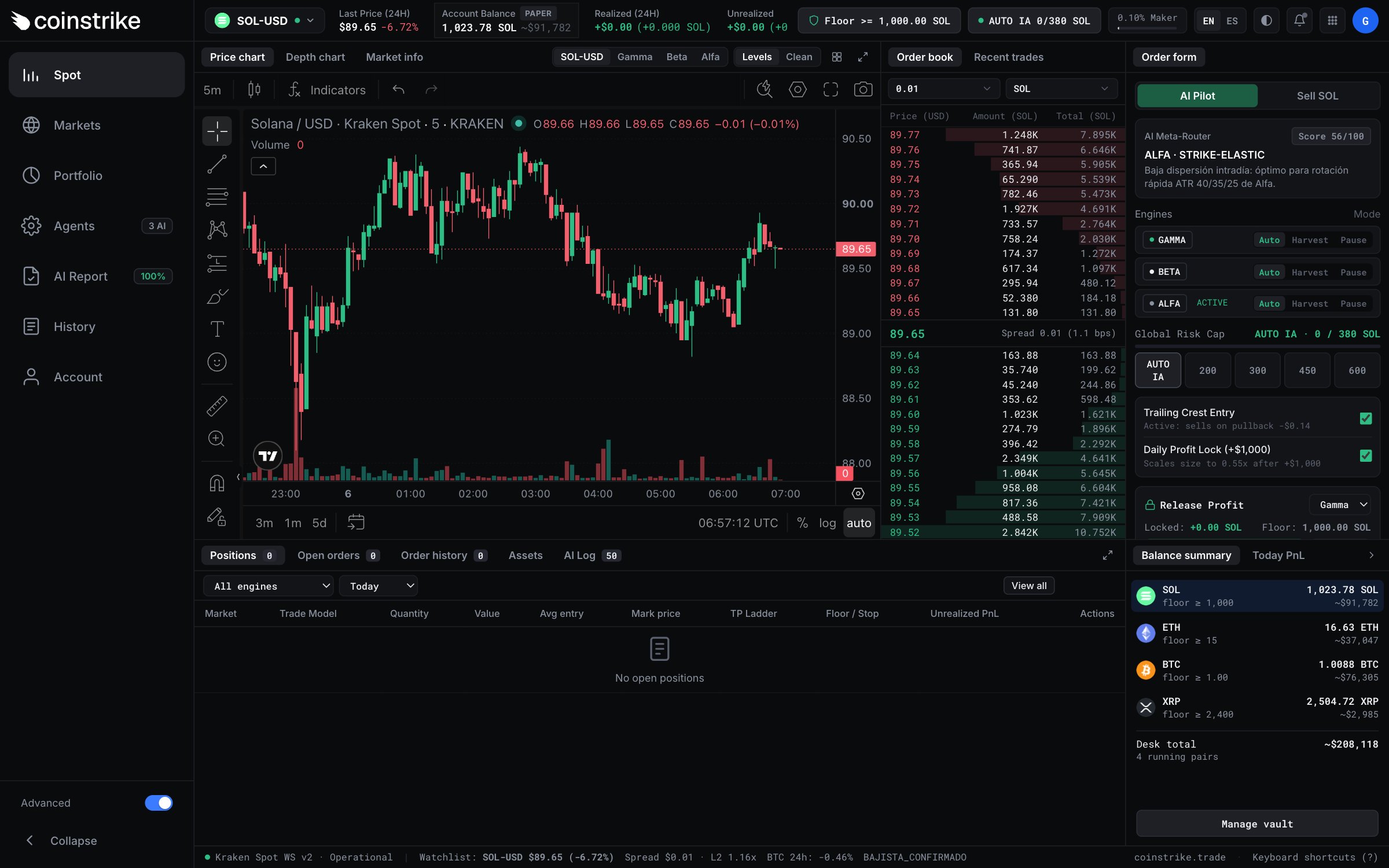
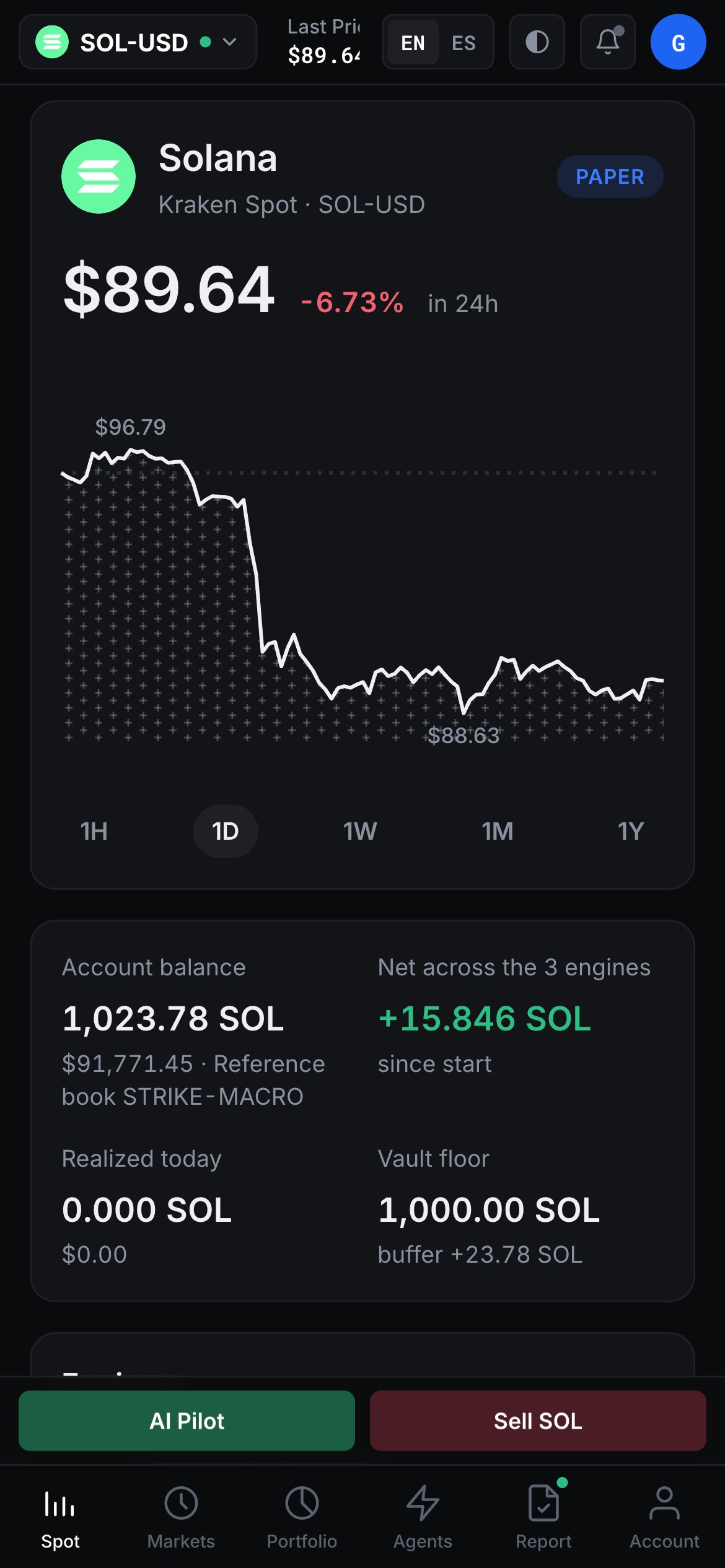
Engine figures are their live books since launch, shown as a change in coins relative to each engine's starting balance.
Holders lose coins when they sell bottoms and chase tops. Coin Strike does the opposite, automatically and without leverage.
Sell at the crestPost-Only ask once price turns down
Buy back in steps40 · 35 · 25 % of the position
Keep the differencebooked in coins after fees
Multi-timeframe EMAs, Z-score stretch, RSI and the live tape score every bounce. A trailing entry follows the crest and places a Post-Only ask only once price turns down.
The engine buys back in tranches, raises a profit floor as the drop deepens and rescues positions that stayed underwater back to green before closing them.
Every cycle is booked as coins gained or lost after Kraken fees. A dollar profit that leaves you with fewer coins is not a win here.
Kraken's SOL, BTC, ETH and XRP candles, the top of the book and what the engines think right now: the same data the terminal trades on.
Each engine runs its own book and is sized so its worst case stays above a protected floor. The figures are their live books, relative to each engine's starting balance.
Fast intraday rebounds.ATR-adaptive ladder that buys back 40 / 35 / 25 % of the position, with a continuous profit ratchet on the runner.
Waits for a stronger signal.Enters only with higher conviction and a stretched bounce, sizes up when the signal is strong and uses the same adaptive ladder.
Defends the bear-market structure.Staged macro entries under the daily averages with partial 30 / 30 / 40 % harvests, plus tactical scalps that recycle the coins it gains.
A forward simulation decides whether an entry has an edge right now. A backtest replays the whole strategy on real history to show what it would have done.
Block bootstrap of Kraken history conditioned on hour, EMA regime and stretch, combined with the 30 most similar historical setups. It gates every entry: no edge, no trade.
The live engine itself replays Kraken candles with a simulated clock, so every timeout, ladder and floor rule fires exactly as in production, and it never peeks at future candles.

Live books since -- and the latest real-engine backtests, as a change in coins relative to each engine's starting balance, so they compare across account sizes.
| Engine | Live | W / L | Backtest 90 d | Backtest long |
|---|---|---|---|---|
| Loading… | ||||
Live results come from the engines' books on Kraken's live order book and tape. Backtests replay the same engine over Kraken candles with a neutral order book, no news and no AI committee, using the engine's own simulated fills and fees. Simulated results do not guarantee future returns.
Install the terminal from your browser as an app. It keeps the same live chart, books and controls, and it can alert you the moment an engine acts.
Alert formats, shown with example values.
Every entry has to pass all of them. Missing data or an unavailable AI never counts as an approval.
Positions are sized so each engine's worst case stays above its protected floor; if its balance gets close, the engine buys back.
One cap for all three engines together, scaled with conviction, so they never pile into the same move.
No entry without a positive expected value after Kraken fees from the 10,000-path simulation.
Claude (Anthropic) reads the news and context and can veto an entry or scale it down. Its silence never approves a trade.
Post-Only orders by default to pay maker fees; taker orders only for protective exits.
Orders go through your own Kraken API keys, enabled per operator. Keys that can withdraw funds are rejected.
Coin Strike is software that places spot orders on your own Kraken account. It never holds your funds.
API keys with withdrawal permission are rejected for live trading, so the software can trade but cannot move funds out.
Kraken and AI keys are stored encrypted (AES-256-GCM) and are never sent back to the browser after saving.
Accounts are created by invitation and sessions use signed, HttpOnly cookies.
Fonts and scripts are served from our own server, with no advertising or analytics trackers.
The engine prices every cycle with Kraken Pro Spot maker and taker fees for your 30-day volume. In live mode it reads your account's actual rates.
| 30-day volume (USD) | Maker | Taker |
|---|---|---|
| Loading… | ||
Fee schedule as modelled by the engine; check Kraken's site for the current official schedule.
Access is by invitation. Tell us a little about you and we will reach out personally.
You do, on Kraken. Coin Strike never custodies assets and rejects API keys that can withdraw funds.
The goal is to finish each cycle with more coins than you started with. A dollar gain that costs you coins does not count as a win.
Yes. Stops, fees and fast rallies can produce losing cycles, and a long losing streak can leave an engine close to its floor. The backtests on this page include those losses.
Claude (Anthropic) reviews headlines and market context and returns a verdict: approve, scale down, tighten the profit floor or veto. The rules and the Time Machine still decide; the AI can only make the system more careful.
SOL, BTC, ETH and XRP against USD on Kraken Spot. No futures, no leverage.